
Bench Warrants in Miller County
A bench warrant is a judge's order tied to a case already open. It can follow a missed hearing, an unpaid fine, a citation left unanswered, or some other court requirement left unmet. In Georgia records, failure to appear, often shortened to FTA, means the person did not show up or resolve the matter as the court required. A capias is court process directing that a person be brought before the court. Labels vary, so ask the clerk what the entry means in your case. Miller County posts no bench-warrant list, no warrant search form, and no recall schedule. That gap is not proof the order is absent. It just means confirmation starts with the office holding the live record. The Miller County Sheriff's Office handles countywide enforcement and the jail, while the issuing court keeps the docket, the missed setting, any judicial action, and any later recall.
Miller Bench Warrant Contact Chain
The first question is not which database has a name. It is which court set the duty. A Miller County warrant concern can start with the sheriff, but a court-held document belongs with the issuing clerk. A city citation stays on the Colquitt court route. Each channel answers a different part of the problem.
| Official channel | Bench-warrant role | Verified contact |
|---|---|---|
| Miller County Sheriff’s Office | County confirmation procedure, service, custody, and jail information | 300 W. Pine Street; 229-758-3421 |
| Superior Court and Clerk | Criminal cases, criminal warrants, filings, and docket records | Room 103; 229-758-4102 |
| Magistrate and Probate Courts | Warrant functions, first appearance, bond, and post-2025 assigned matters | Room 110; 229-758-4110 |
| Colquitt Municipal Court | City citations, ordinance cases, fines, and missed city court dates | 154 West Street; 229-758-1006 |
The courthouse offices sit at 155 South First Street in Colquitt, open weekdays from 9:00 a.m. to 5:00 p.m. The sheriff page promises no phone confirmation and posts no walk-in warrant hours. Call first. Ask what method and identifying details that office requires. Georgia's official existing-warrant guidance warns that asking in person can lead to custody when an active warrant exists.
How a Bench Warrant Is Issued
A Miller County judge issues a bench warrant from a case already before that judge. The record should tie the order to the underlying case, the unmet obligation, and the issuing court. That is different from treating a missed date as a new probable-cause complaint. Clerks can explain procedure and record facts. They cannot advise you on contesting the order or picking a legal strategy. Traffic matters carry an extra Georgia notice rule. Before the bench-warrant step for a traffic offense, Senate Bill 10 requires the clerk to mail a notice or postcard that gives you a period to dispose of the case, waive arraignment, or plead not guilty. The signed law controls the exact terms, and it does not promise that notice ends the case, bars a later warrant, or sets one uniform local form. Miller County has no verified grace period, automatic recall, or standard motion form. A recall or quash is a judge's act withdrawing or ending the warrant. Only a court order, or a current confirmation from the issuing office, proves that this happened.
Miller Bench Warrant Search Limits
A blank web result proves nothing. No Miller County bench warrant may still exist, and the sheriff offers no public warrant search. The clerk's official site links a case system, but the link has never settled on a stable destination, so its search fields and warrant coverage remain unknown. Georgia eAccess lists Miller court entries and requires provider access, and its landing page does not say which warrant events appear in a public result.
Myth and fact: A court docket, payment screen, or missing search result may offer a lead, but none independently proves current warrant status.
The Georgia Crime Information Center supports restricted criminal-justice access to wanted-person files. It is not a public name-search portal. Colquitt's online payment route is narrower still. It takes a citation or driver's-license number for eligible payments, but the city does not offer it as a warrant lookup or proof of recall. For a current concern, ask the Miller County sheriff and the issuing court directly.
Bench Warrant vs Arrest Warrant
Both orders can put a person in custody, but they arrive by different paths. A bench warrant usually follows a missed duty in a case already open. An arrest warrant generally follows a warrant application and a judicial finding tied to an alleged offense. Miller Magistrate Court handles arrest-warrant and search-warrant applications among its criminal functions. Knowing the difference helps a caller ask the right office for the right document.
| Feature | Bench warrant | Arrest warrant |
|---|---|---|
| Common starting point | Missed setting, fine, citation response, or court condition | Application alleging facts that support issuance |
| Case posture | Usually an existing court matter | May begin a criminal process |
| Key record holder | Issuing court and clerk | Issuing court, clerk, and serving agency |
| Key next question | What must occur for judicial review or recall? | What is the safe surrender, first-appearance, and bond process? |
Issuance and service are separate steps. A judge issues process, and the Miller County sheriff's department processes and may serve those court orders. The court alone decides whether its bench warrant stays in force, while the sheriff can explain current confirmation and custody procedure.
Missed a Miller Bench Warrant Date
Act quickly once you realize a court date was missed. The court named on your paperwork is the one to call. A citation or notice listing Colquitt Municipal Court means its clerk comes first, before any city payment page. County court paperwork goes to that clerk instead. When the jurisdiction is unclear, the sheriff can confirm which Miller County court holds the case. Dispatch at Miller-Baker E911 is not a records desk, so save it for emergencies.
- Gather the case or citation number, court name, and missed date if known.
- Ask the clerk what the docket shows and whether a bench warrant was issued.
- Ask whether a new appearance, payment, filing, bond, or judge’s order is required.
- Consider speaking with counsel before any visit that could lead to custody.
- Keep the receipt, new notice, and signed order, then confirm the live status again.
Paying a displayed balance does not by itself cancel a Miller County bench warrant. Money may be settled while the missed setting still stands. Only the judge can lift the order. Court staff can explain procedure, but questions about a motion, a defense, or a surrender plan belong with a lawyer.
How to Resolve a Miller County Bench Warrant
Start with verified jurisdiction and current status. Ask the issuing clerk what the judge requires next. Miller County publishes no local recall form or guaranteed procedure. A lawyer may seek a new setting or ask the court to recall or quash the warrant. If surrender is required, call the sheriff or court first for current instructions.
Caution: An in-person warrant inquiry may result in custody, so verify the office and consider legal advice before arriving.
One step rarely finishes a Miller County case. Posting bond handles release. It does not erase the charge or citation, and paying a fine may not recall the warrant. Another court date can still remain. After each official instruction, ask for the order or receipt and confirm that both the warrant entry and the underlying duty were addressed. The Miller County warrant records process page also explains the split between court and sheriff.
Miller Bench Warrant Bond Questions
Bond starts in Magistrate Court, which handles first appearance and bond functions, while the sheriff runs the jail. Georgia guidance names the possible bail forms. They include recognizance or unsecured release, secured bond, cash deposited with the sheriff, personal surety, commercial surety, and property bond. Those are statewide categories only. They are not a Miller County bond schedule or a promise that any option fits one bench warrant.
- First appearance
- An initial court proceeding after arrest that addresses rights and other early case matters.
- Bond condition
- A court rule attached to release that the person must follow.
- Bond forfeiture
- A loss of posted security after a failure defined by the court.
- Recognizance
- Release based on a promise to return, without the same secured deposit.
- Revocation
- A court’s withdrawal of an earlier release decision.
Miller County publishes no bond schedule, no payment-method list, and no bondsman list. No bond-window hours or warrant-recall fee appear either. Ask which court sets the terms and which payments it accepts. A general Georgia bail category is not a Miller-specific dollar amount.
Which Miller County Court Issued It
The issuing court controls the bench warrant. The Miller County Superior Court page says that court keeps criminal cases and criminal warrants. The Miller County Magistrate Court page covers warrant applications, first appearance, bond, extradition, committal, and related hearings. Probate Court now handles some limited criminal and traffic functions. Colquitt Municipal Court stays the city route. Municipal citations and ordinance matters go there. Miller State Court was abolished effective January 1, 2025. House Bill 864 moved criminal matters within Probate jurisdiction to Probate Court and sent other criminal actions to Superior Court. An old notice may still say Miller State Court. That label is not proof of the current office. Give the clerk the old case details and ask where the record moved. Georgia's official court-class diagram lays out these trial-court roles. See Navigating Georgia's Courts for the source.
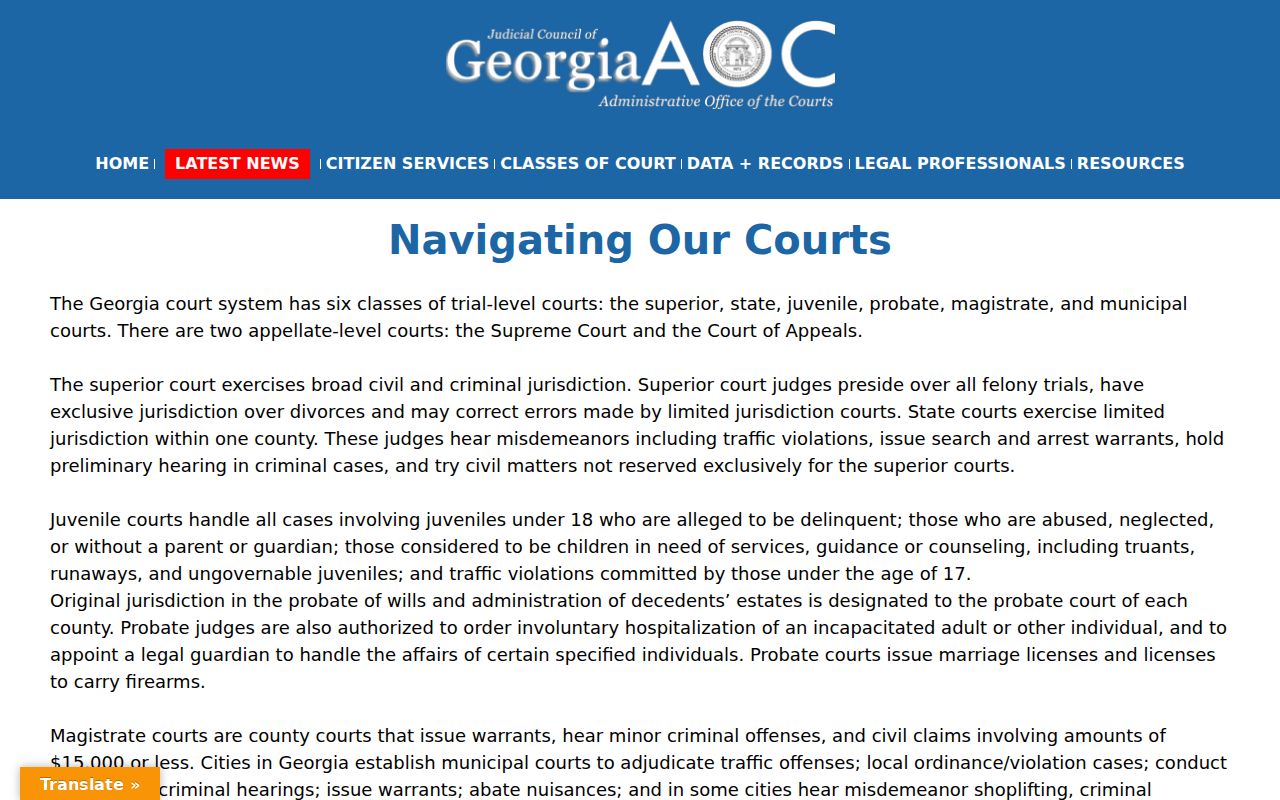
That diagram is a jurisdiction guide, not a live Miller County bench-warrant search. Current status still comes from the local office.
Miller Bench Warrant Records Requests
A records request is not an urgent status check. It fits Miller County documents and history instead. You can seek an application, issued order, return, docket entry, bond document, or written office policy. Miller County's Open Records Request Form is a paper form with requestor and records-description fields. The county forms page says you may download it, print it, and send it by fax, postal mail, or hand delivery. Send it to the Miller County office holding the record. The form itself directs constitutional-office records to the sheriff, clerk of court, or Magistrate/Probate office involved. Name the court, record type, date range, and case or citation number if you have them. Ask to inspect or get copies. Get a cost estimate before large production. The Georgia Open Records Act does not force an agency to build a bench-warrant list it never kept. Access still depends on the law. Pending investigative material, a confidential source, a sealed record, juvenile information, or protected personal data may be withheld or redacted. Georgia guidance generally calls for access within three business days. A slower office must instead send a written response covering timing, cost, and any exemption. A records response helps with documents and history. For present warrant status, direct contact with the Miller County court and sheriff remains the safer route.